
Why your biggest communication problem might not be communication at all
When organisations talk about improving communication, the conversation often turns to channels, messaging and meetings.
Should we send more updates? Hold more town halls? Introduce another collaboration platform?
But what if communication isn’t the real problem?
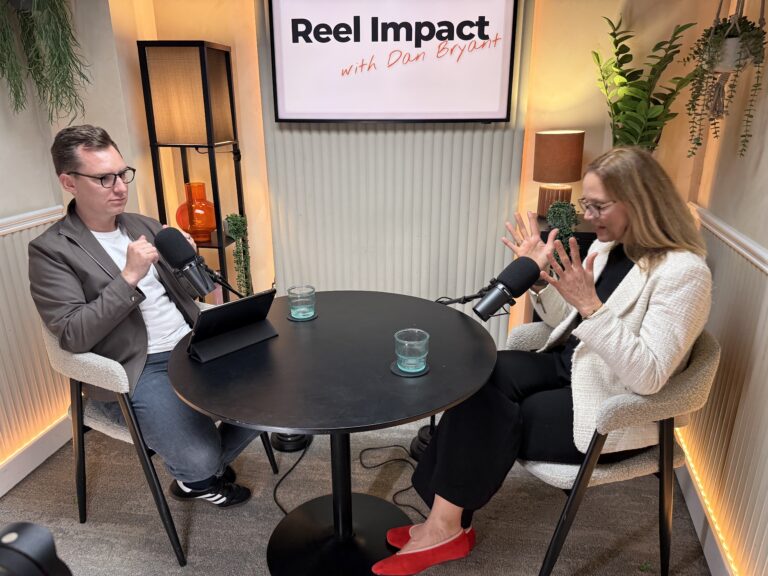
That was the central question explored in the latest episode of Reel Impact, where host Dan Bryant sat down with chartered psychologist and neuroscientist Dr Amanda Potter to discuss why communication breaks down and what leaders can do about it.
Rather than focusing on tactics, Amanda argues that communication is simply the visible symptom of something much deeper.
Communication creates clarity
Amanda describes communication as “the true foundation of success.”
Without it, organisations struggle to create clarity around purpose, priorities and expectations. Teams become uncertain about what they’re trying to achieve and individuals begin to question where they fit.
The challenge is that communication isn’t just about speaking clearly.
It’s about creating an environment where people feel able to ask questions, challenge ideas and admit when something isn’t working.
Without that foundation, clarity quickly disappears.
Why trust matters more than communication
One of the strongest themes throughout the conversation is trust.
Amanda explains that trust isn’t something that appears because leaders ask for it. It develops through relationships, openness and psychological safety.
Psychological safety describes an environment where people feel able to speak honestly without fear of embarrassment, criticism or negative consequences.
These are the teams where people challenge assumptions, ask difficult questions and raise concerns before small problems become expensive ones.
When that safety doesn’t exist, communication becomes filtered. People tell leaders what they think they want to hear rather than what they need to hear.
The result is poor decision-making and missed opportunities.
Do organisations really want people to bring their whole selves to work?
Amanda also challenges one of the most common phrases found in workplace values.
“Bring your whole self to work.”
Her argument isn’t that authenticity doesn’t matter.
It’s that work naturally requires us to behave differently depending on the situation. We all adapt our behaviour, whether we’re speaking to colleagues, customers or family members.
The real objective shouldn’t necessarily be bringing our whole selves to work.
It should be creating an environment where people can bring the best version of themselves, while feeling confident enough to contribute honestly.
It’s a subtle difference, but an important one.
The hidden cost of hybrid working
Perhaps Amanda’s most controversial opinion centres on hybrid working.
Using the analogy of cake, she explains that while many people enjoy hybrid working, it may also carry unintended consequences.
Drawing on research carried out with organisations around the world, Amanda explains that hybrid teams often report lower levels of psychological safety than either fully office-based or fully remote teams.
The reason isn’t simply location.
Hybrid employees can feel caught between two worlds.
They miss informal conversations, question whether they’re fully included and often experience a low-level sense of uncertainty about what’s happening around them.
That uncertainty places the brain into a heightened state of alert, making it harder to build resilience, trust and belonging.
Amanda is careful not to suggest hybrid working cannot succeed.
Instead, she argues that organisations achieving the best outcomes introduce clear structure around when teams work together, creating meaningful opportunities for connection rather than simply sharing office space.
Why being “nice” isn’t always a good sign
Another idea Amanda turns on its head is the belief that nice teams are healthy teams.
In reality, excessive politeness can sometimes indicate the opposite.
If everyone agrees with each other, avoids difficult conversations and never challenges ideas, it may suggest people are more concerned with keeping the peace than improving performance.
Amanda introduces the concept of “functional stupidity” – where intelligent people gradually stop thinking independently and become order takers.
Questions disappear.
Challenge disappears.
Innovation disappears.
Healthy organisations don’t encourage conflict for its own sake.
They encourage respectful challenge through honesty, curiosity and what Amanda describes as kindness with candour.
Leadership has more influence than leaders realise
Throughout the episode, Amanda returns to leadership behaviours.
Some of the most committed and hardworking leaders unintentionally create the least psychologically safe environments.
The reason?
Relentless standards, constant pressure and an overwhelming desire to achieve results can leave little room for discussion or disagreement.
The intention may be positive.
The impact often isn’t.
As Amanda puts it, “the path to hell is paved with great intention.”
Leaders who genuinely want better communication need to recognise that communication isn’t something they simply deliver.
It’s something they create through the environment they build every day.
Small habits make a big difference
The conversation finishes with practical advice.
Rather than suggesting dramatic organisational change, Amanda encourages leaders to start with themselves.
Building resilience through simple daily habits – sleeping well, getting outside early, moving more and looking after personal wellbeing – improves emotional regulation and ultimately influences how leaders communicate with others.
Because healthier, more resilient leaders are more likely to create healthier, more resilient teams.
Watch or listen to the full episode
Communication breakdown rarely starts with communication.
It starts with trust, leadership, relationships and whether people feel safe enough to speak honestly.
If you’re responsible for leading people, shaping culture or improving communication within your organisation, this episode offers plenty to challenge your thinking.
Listen to The Communication Breakdown with Dr Amanda Potter on Reel Impact with Dan Bryant.
Want to work with us?
Find out how you can inspire your people through video by getting in touch today.
