
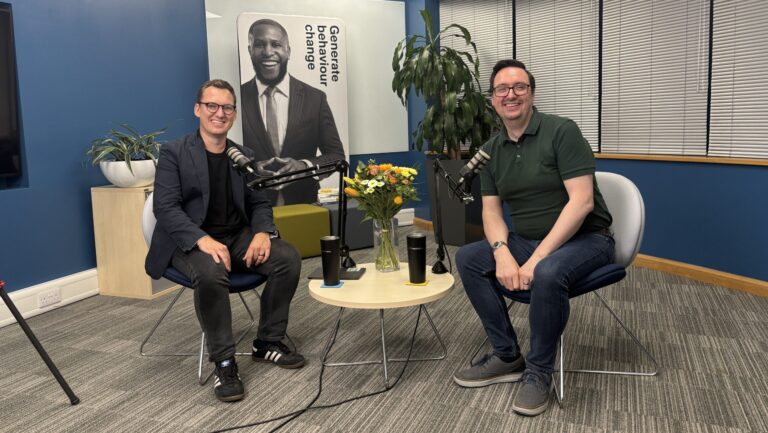
In the latest episode of Reel Impact, Dan is joined by Paul Coates, Head of International Consultant and Delivery Excellence at FranklinCovey. With more than two decades in learning and development leadership – and a rare perspective as both former client and senior leader – Paul offers a refreshingly honest view on what it really takes to create learning that sticks.
One thing becomes clear early in the conversation: the traditional idea of “training” is no longer enough.
From one-off training to leadership-led journeys
Organisations have always faced change. What’s shifted is how that change needs to be supported. For Paul, the biggest evolution in learning and development isn’t about new tools or platforms – it’s about moving away from isolated training events and towards leadership-led learning journeys.
Rather than asking “What training do people need?”, the better question is: What result are we actually trying to achieve? Whether it’s navigating a merger, reshaping culture or helping teams cope with uncertainty, effective learning now starts with intentionality. It requires clarity on outcomes, alignment at leadership level and a focus on real behaviour change, not just knowledge transfer.
Paul is clear: change succeeds or fails based on how it is led. Leaders don’t just sponsor learning; they model it. When learning becomes something “for them out there”, momentum stalls. When leaders go first, people follow.
The five essentials for learning that sticks
Throughout the episode, Paul returns to five essentials that underpin sustainable behaviour change:
-
Intentional design – learning must be built around a clear business outcome, not vague aspirations.
-
Leadership alignment – leaders must actively lead and champion the change.
-
A shared language – frameworks and common terminology give people a way to talk about behaviour consistently.
-
Reinforcement and accountability – habits don’t form without follow-up and expectation.
-
Blended journeys – combining live experiences with digital reinforcement over time.
This is where many organisations fall short. Too often, learning is treated as a moment in time rather than an ongoing experience. Without reinforcement, even the best sessions fade quickly, a reality Paul links to the well-known “forgetting curve”.
Why storytelling changes behaviour
One of the most compelling parts of the conversation centres on storytelling. For Paul, stories aren’t a “nice to have” – they are fundamental to learning.
People rarely change behaviour because of information alone. They change because they feel something. Stories create that emotional connection, helping people see themselves in the situation and motivating them to act differently.
But storytelling has to be intentional. In the room, it’s not about the facilitator being the hero of the story. It’s about using stories to unlock other people’s experiences. And at scale – across teams, countries and cultures – consistency becomes critical.
This is where video plays a powerful role.
Why real stories beat polished performances
Paul explains why FranklinCovey has increasingly shifted away from actor-led content towards real people telling real stories. Today’s audiences are immersed in high-quality media every day. If corporate video feels staged or artificial, it risks losing credibility.
Authentic stories, on the other hand, are easier to trust and easier to relate to. Video becomes a way to ensure storytelling is consistent, emotionally resonant and scalable, regardless of who is facilitating the learning.
Crucially, Paul challenges the assumption that everyone wants to create content. While user-generated content works brilliantly for a small minority, most people prefer to consume rather than create. The real opportunity lies in intentionally drawing stories out of people, supporting them to share experiences that might otherwise remain unheard.
One example Paul shares – a senior leader speaking openly on video about becoming a better parent through work-based learning – demonstrates just how powerful this can be when done well.
Culture change starts with visibility
Perhaps the most thought-provoking insight comes towards the end of the conversation. Paul argues that the single biggest factor in building a strong learning culture is leadership visibility.
Culture, he says, is simply “the way we do things around here”. And people will only do it when they see it being done. When leaders openly practise what they promote – even imperfectly – it creates permission for everyone else to try.
Learning, then, cannot be something leaders delegate. It has to include them. When leaders are visibly learning, reflecting and applying ideas in real situations, it breaks down barriers and builds trust.
As Paul puts it:
“If leaders aren’t up for learning themselves, why should anyone else be?”
Reel Impact: conversations that go deeper
Paul Coates’ episode is a powerful reminder that learning, communication and storytelling are deeply connected. Real impact doesn’t come from polished messages or one-off interventions – it comes from intentional design, authentic stories and leaders who are willing to go first.
🎙️ Reel Impact is dmb films’ podcast exploring how organisations communicate with creativity, clarity and purpose. You can listen to this episode and others in the series on your favourite podcast platform.
🔍 Search for Reel Impact wherever you get your podcasts.
